Two-Screw Dam Gate
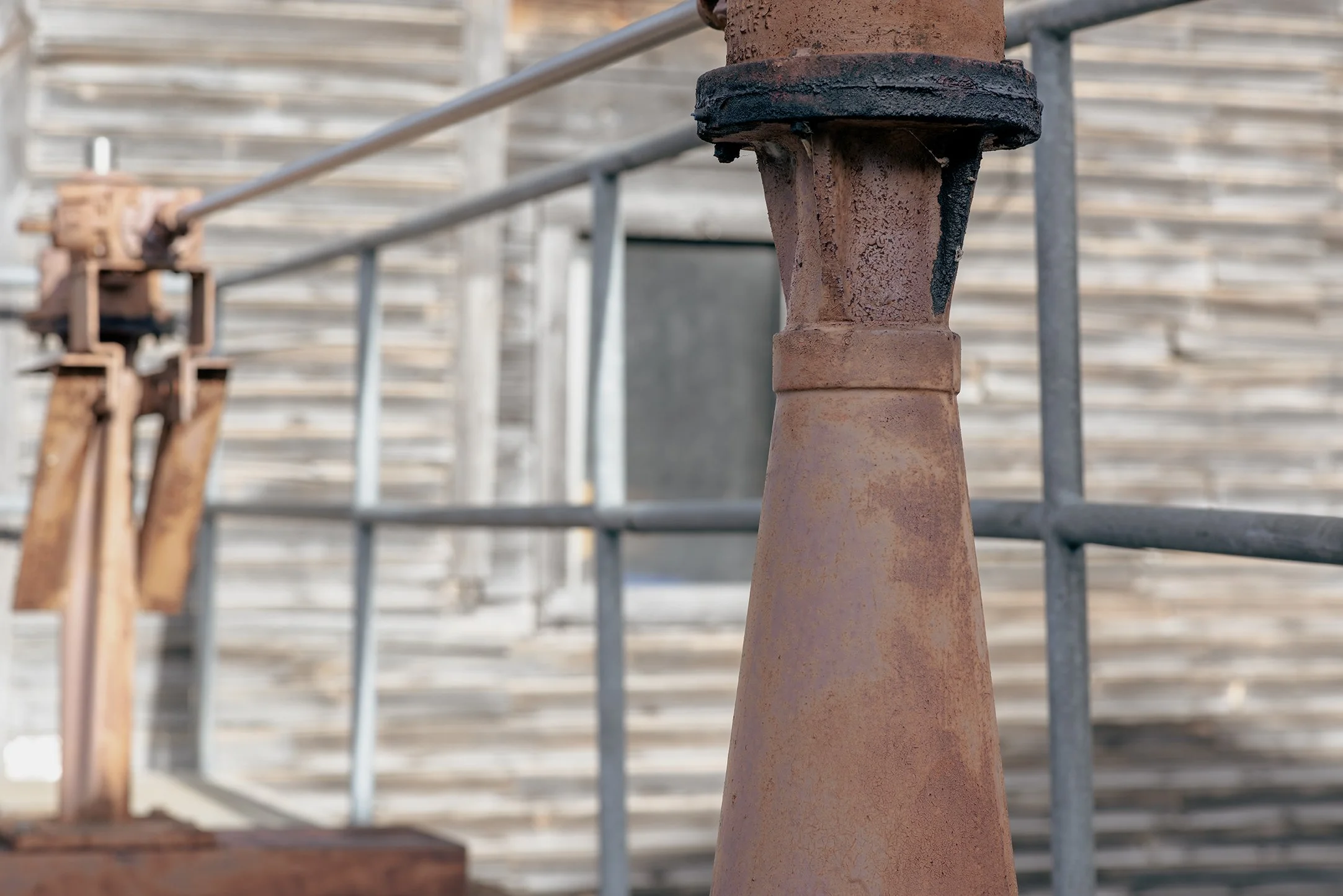
Two-Screw Dam Gate
Taylor Brook Grist and Carding, c. 1772
Taylor Brook
Auburn, Androscoggin County, Maine
From the Echoes, Still: Maine's Industrial Remnants Collection (2024–2028) Machinery Portfolio
Historical Narrative
Kevin LeDuc Pigment print on Hahnemühle Baryta Edition of 5 + 1 Artist's Proof (Portfolio of 40 Images)
Paper Size: 40 × 55 inches Image Size: 31.33 × 37 inches Borders: Approximately 4 inches (All Sides)
Historic Significance
Historical Narrative
-
The Two-Screw Dam Gate: Mechanical Control of Water Power at a New England Grist Mill
Introduction
Among the surviving components of historic water-powered mills, few illustrate the relationship between natural energy and mechanical engineering as clearly as the two-screw dam gate lifting mechanism. At the Taylor Brook Grist and Carding Mill site in Auburn, Maine, the remaining iron operating apparatus mounted on the concrete dam represents a later generation of water-control technology that continued a tradition dating back to the earliest colonial mills. Although the original eighteenth-century mill relied on timber construction and simple water-control devices, the surviving mechanism reflects the nineteenth- and early twentieth-century transition toward standardized iron hardware, improved reliability, and greater control of industrial water systems.
The device is best identified as a two-screw sluice gate lifting mechanism. Its purpose was not to pump water but to regulate it. By raising and lowering a gate installed within the dam or mill-race entrance, the mill operator could control the amount of water delivered to the water wheel or turbine. The mechanism transformed manual effort into controlled vertical movement, allowing a single operator to manage a large gate exposed to the considerable pressure of stored water.¹
Purpose of the Dam Gate
A water-powered grist or carding mill depended on the controlled release of stored water. A dam created a reservoir or millpond, providing a reliable supply above the level of the mill machinery. The dam gate served as the point of control between the stored water and the mill’s power system. When opened, water flowed through a raceway, flume, or penstock toward the wheel. When closed, the flow stopped and the machinery could be safely shut down.²
Without a reliable gate system, the mill operator could not regulate production. Too much water could overspeed a wheel, damage machinery, or create unsafe conditions. Too little water reduced efficiency or stopped production entirely. The dam gate therefore functioned as the equivalent of a mechanical throttle, controlling the amount of energy delivered from the stream to the mill.
Early New England mills commonly used wooden gates operated by levers, chains, or simple lifting devices. These systems were effective but subject to wear, swelling, freezing, and distortion. As mills expanded and water-control requirements became more demanding, manufacturers developed stronger iron and steel gate-operating systems.³
Construction and Mechanical Design
The surviving Taylor Brook mechanism consists of two vertical threaded metal stems approximately two inches in diameter, mounted on separate concrete pedestals. The two stems are connected by a horizontal operating shaft approximately ten to twelve feet apart. This arrangement identifies the system as a synchronized two-screw gate operator.
Each vertical threaded stem acted as a lifting screw. A threaded nut or gear assembly, turned by a crank or handwheel through the connecting shaft, caused the stem to move vertically. Because the screw converted rotary motion into linear motion, the operator could lift a heavy gate with relatively modest effort. The fine mechanical advantage of the screw allowed a person to move a gate weighing hundreds or even thousands of pounds while maintaining precise control.⁴
The two-screw design was necessary because mill gates were often too wide and heavy for a single lifting point. A single screw could cause the gate to twist, bind in its guides, or place unequal stress on the gate structure. Two screws positioned near the ends of the gate distributed the load evenly. The connecting shaft ensured that both sides rose or fell together, keeping the gate level during operation.⁵
The missing gate itself would have been located below the dam crest or within a framed opening. It was likely constructed of heavy timber, iron, or a combination of both. The remaining operating machinery represents only the lifting system; the actual barrier controlling the water has disappeared through decay, replacement, or removal.
Evolution of Mill Gate Technology
The history of this mechanism follows the broader development of American water-power engineering. During the eighteenth century, when the Taylor Brook mill was established, most mill hardware was produced locally by craftsmen. Millwrights built wooden dams, races, wheels, and gates using available timber and hand-forged hardware. These systems were practical but required frequent maintenance.
During the nineteenth century, industrial growth encouraged the standardization of mill components. Iron foundries and machine shops began producing specialized water-control equipment, including gate frames, turbine components, and screw-operated lifting devices. Manufacturers in New England became important suppliers to textile mills, sawmills, grist mills, and hydroelectric installations.⁶
Companies such as the Holyoke Machine Company of Massachusetts produced water-power equipment and helped spread standardized engineering practices throughout New England. Similar regional manufacturers produced turbines, gearing, and hydraulic hardware as mills modernized during the industrial period.⁷
By the late nineteenth and early twentieth centuries, concrete dams became increasingly common. Concrete provided greater strength and durability than earlier timber structures and allowed the installation of heavier mechanical gate equipment. A two-screw gate operator mounted on concrete is therefore consistent with a modernization phase rather than the original construction of an eighteenth-century mill.
Industrial Importance
The importance of the two-screw dam gate extends beyond its mechanical function. It represents the point where traditional water power met industrial engineering. A mill depended upon a delicate balance between nature and machinery. The stream provided energy, but only a carefully controlled system could convert that energy into useful production.
The operator who turned the gate mechanism was controlling the entire mill’s power supply. A small movement of the screw could alter water flow, change wheel speed, and affect the operation of grinding stones or carding machinery. The mechanism therefore represented both physical strength and precision engineering.
Unlike engines powered by coal, steam, or electricity, water-powered mills required constant adjustment to changing environmental conditions. Seasonal variations in rainfall, ice, and stream flow required operators to regulate water carefully. The dam gate was the essential instrument that made dependable operation possible.
Preservation Significance
The surviving two-screw dam gate mechanism at Taylor Brook is an important example of the practical engineering that supported New England’s rural industries. While the gate itself is gone, the remaining screws, supports, and connecting shaft preserve evidence of how the mill interacted with its water source.
The apparatus demonstrates a period when older water-powered industries adopted improved mechanical systems while continuing to rely on traditional renewable energy. It is not simply a piece of iron hardware; it is a record of industrial adaptation, showing how mill operators improved control over a resource that had powered communities for generations.
The mechanism likely dates from a later improvement period, perhaps the late nineteenth or early twentieth century, when concrete dams and manufactured iron gate equipment replaced earlier wooden systems. Its survival provides a tangible connection between early New England milling traditions and the engineering advances that allowed water-powered industries to continue operating into the modern era.
Footnotes
Robert B. Gordon, American Iron, 1607–1900 (Baltimore: Johns Hopkins University Press, 1996), 214–218.
Theodore R. Hazen, The Technology of the New England Grist Mill (Charlottesville: University of Virginia Press, 1984), 44–51.
Louis C. Hunter, A History of Industrial Power in the United States, 1780–1930, vol. 1 (Charlottesville: University Press of Virginia, 1979), 42–46.
James F. Hobart, The Millwright and Mill Machinery (New York: Norman W. Henley Publishing, 1907), 171–176.
William F. Durand, Hydraulic Turbines (New York: John Wiley & Sons, 1907), 33–38.
Robert B. Gordon, American Iron, 1607–1900, 251–258.
John H. White Jr., The American Railroad Freight Car: From the Beginning to 1900 (Baltimore: Johns Hopkins University Press, 1978), 18–20; discussion of regional machine manufacturing practices.
Appendix A
Mechanical Description of the Taylor Brook Two-Screw Dam Gate Operator
The surviving mechanism at the Taylor Brook Grist and Carding Mill site is a two-screw dam gate operating system designed to control the movement of a large sluice gate within the mill’s water-control structure. Mounted on the crest of a concrete dam, the mechanism represents a later stage in the development of water-power technology, when traditional mill operations were upgraded with manufactured iron and steel components. Although the original gate assembly is no longer present, the remaining operating hardware provides clear evidence of how the system functioned and how mill operators controlled the flow of water that supplied power to the mill.
The primary components of the mechanism are two vertical threaded steel stems, each approximately two inches in diameter, mounted on separate concrete support pedestals. These screw stems were the main lifting elements of the system. Unlike a simple lever or chain arrangement, the threaded design converted rotary motion into controlled vertical movement. When turned by an operator, the threaded mechanism provided significant mechanical advantage, allowing a relatively small amount of human effort to raise or lower a heavy gate exposed to the force of flowing or stored water.
The two screw stems were positioned approximately ten to twelve feet apart, indicating that the original gate was a substantial width. A single lifting point on a gate of this size would have placed excessive stress on the structure and could have caused the gate to move unevenly, twist, or become lodged in its guides. By using two synchronized lifting screws, the mechanism distributed the load across the width of the gate and maintained a balanced movement during operation.
The two vertical screws were connected by a horizontal operating shaft. This cross shaft was a critical part of the design because it allowed both screw mechanisms to operate together from a single control point. When the operator turned the crank or handwheel attached to the shaft, the rotation was transferred simultaneously to both screw assemblies. This ensured that both sides of the gate rose or descended at the same rate, keeping the gate aligned within its guides and reducing wear on the surrounding structure.
The missing gate would have been located below the operating mechanism, positioned within a framed opening in the dam or at the entrance to the mill race. Depending on the period of installation, the gate itself may have been constructed of heavy timber reinforced with iron fittings or fabricated partly from metal. The purpose of the gate was not to pump water but to regulate its movement. By controlling the size of the opening, the mill operator could determine how much water entered the raceway and reached the water wheel or turbine.
The operating sequence was straightforward. The mill worker first rotated the crank or handwheel connected to the cross shaft. The shaft transferred this motion to the two screw mechanisms. As the threaded stems moved through their nuts or lifting assemblies, they raised or lowered the attached gate. Raising the gate allowed more water to pass through the dam opening, increasing the available power at the mill machinery. Lowering the gate restricted the flow, reducing power or completely stopping the water supply when the mill was shut down or maintenance was required.
The two-screw arrangement was particularly valuable in water-powered mills because operating conditions were constantly changing. Stream flow varied with rainfall, drought, snowmelt, and seasonal freezing. A mill operator needed a reliable method to adjust water delivery quickly and precisely. The screw mechanism provided both control and security because the threaded system resisted accidental movement under the pressure of the water.
The physical characteristics of the Taylor Brook mechanism suggest that it was not part of the original eighteenth-century construction of the mill but rather a later improvement. Early New England mills commonly used wooden sluice gates operated by simple lifting devices made by local millwrights. During the nineteenth century, improvements in iron production, machine-tool manufacturing, and hydraulic engineering led to more standardized gate operators. By the late nineteenth and early twentieth centuries, concrete dams and manufactured metal gate systems had become common replacements for earlier timber structures.
The Taylor Brook mechanism therefore represents a period of transition in New England industrial history. It reflects the continued importance of water power while demonstrating the adoption of improved mechanical technology. The mill continued to depend on the natural energy of Taylor Brook, but the method of controlling that energy had become more precise, durable, and efficient.
As an artifact, the two-screw dam gate operator preserves an important piece of industrial engineering history. It represents the practical knowledge required to transform a flowing stream into dependable mechanical power. Although the gate and much of the original water-control system have disappeared, the surviving screws, supports, and connecting shaft continue to document the relationship between water, machinery, and the industries that depended upon them.
Bibliography
Gordon, Robert B. American Iron, 1607–1900. Baltimore: Johns Hopkins University Press, 1996.
Hazen, Theodore R. The Technology of the New England Grist Mill. Charlottesville: University of Virginia Press, 1984.
Hobart, James F. The Millwright and Mill Machinery. New York: Norman W. Henley Publishing, 1907.
Hunter, Louis C. A History of Industrial Power in the United States, 1780–1930. Vol. 1. Charlottesville: University Press of Virginia, 1979.
Durand, William F. Hydraulic Turbines. New York: John Wiley & Sons, 1907.
White, John H. Jr. The American Railroad Freight Car: From the Beginning to 1900. Baltimore: Johns Hopkins University Press, 1978.
Holyoke Machine Company. Historical Catalogs and Engineering Publications. Holyoke, Massachusetts.
-
Built: c. 1772–1780
Before Auburn emerged as a center of large-scale textile manufacturing along the Androscoggin River, its economy depended on a dense network of small, water-powered mills situated on local streams and brooks. Among the most significant of these early enterprises was the grist mill located on Taylor Brook at the present-day crossing of Minot Avenue in Auburn, Maine.¹ Dating to c. 1772–1780, this site represents the earliest phase of Auburn’s industrial development, when milling was closely tied to agriculture, local self-sufficiency, and community survival.
The mill was originally constructed by members of the Stevens family, who played a central role in developing early milling operations along Taylor Brook.² They took advantage of the approximately thirty-foot drop from Taylor Pond toward the Androscoggin River, a natural gradient that provided reliable waterpower for grist and saw mills. At the Minot Avenue site, the original structure functioned as a grist mill, grinding locally grown corn, barley, and buckwheat for surrounding farms and forming a crucial link between agricultural production and household consumption at a time when transportation networks were limited and communities were largely self-reliant.³
Grain processed at the mill was converted into essential household products that formed the basis of daily diets in rural Maine. Corn was ground into meal for cornbread, porridge, and johnnycakes; barley was milled for flour used in bread and soups; and buckwheat was processed into flour for pancakes and griddle cakes, staples of nineteenth-century New England households.⁴ Bran and middlings, byproducts of the grinding process, were also used as livestock feed, further integrating the mill into the local agricultural economy.
The history of the Minot Avenue mill also illustrates the adaptability of early milling sites as Auburn’s economy evolved. In 1875, the property was sold to Parsons and Willis and converted into a carding mill.⁵ Carding mills performed a critical preparatory step in woolen textile production: raw wool was washed, cleaned, aligned, and combed into continuous strands, or slivers, suitable for spinning into yarn.⁶ This process transformed locally produced fleece into a standardized industrial material, allowing farmers and small manufacturers to participate in the expanding regional textile economy even as larger mills began to dominate production along the Androscoggin River.
Although smaller than later textile factories, the carding operation likely employed between 10 and 25 workers, including men, women, and sometimes older children.⁷ Employees typically worked long hours—often ten to twelve hours per day—operating carding machines, feeding raw wool, maintaining equipment, and handling finished slivers. Despite this shift toward textile processing, the site reportedly continued grinding grain for local use well into the mid-twentieth century, roughly sixty years prior to the article’s publication, demonstrating the persistence of traditional milling functions alongside newer industrial activities.⁸
This pattern of adaptive reuse was not unique to Taylor Brook. Similar transitions occurred along Foundry Brook and other small waterways in Auburn, where early grist mills were supplemented—or replaced—by sawmills, tanneries, and textile-related operations. Together, these small mills formed an interconnected local economy that supported population growth, shaped transportation routes, and laid the groundwork for Auburn’s later emergence as an industrial center dominated by large brick textile factories at Great Falls.⁹
Although the Minot Avenue mill no longer stands, physical remnants of the dam and mill works remain visible at the site, offering tangible evidence of Auburn’s earliest industrial landscape. As an archaeological and historical resource, the Taylor Brook mill site provides valuable insight into eighteenth- and nineteenth-century milling technology, water management practices, and the economic transition from subsistence agriculture to industrial production.¹⁰ The story of this modest grist and carding mill helps explain how Auburn’s early milling economy established the foundation for the city’s later industrial prominence.¹¹
Footnotes
Dave Sargent, “River Views: Mill loss hits area,” Sun Journal (Lewiston, ME), August 25, 2009.
Earle G. Shettleworth Jr., “Early Industrial Development in Auburn,” Maine History 29, no. 2 (1990): 87–89.
Ibid., 88.
Judith A. McGaw, Most Wonderful Machine: Mechanization and Social Change in Berkshire Paper Making, 1801–1885 (Princeton, NJ: Princeton University Press, 1987), 22–24.
Shettleworth, “Early Industrial Development in Auburn,” 90.
Thomas Dublin, Women at Work: The Transformation of Work and Community in Lowell, Massachusetts, 1826–1860 (New York: Columbia University Press, 1979), 41–43.
Maine Bureau of Industrial and Labor Statistics, Annual Report (Augusta: State of Maine, 1885), 97.
Sargent, “River Views: Mill loss hits area.”
Robert M. Frame Jr., Maine Industrial Buildings (Cambridge, MA: MIT Press, 1979), 61–64.
Earle G. Shettleworth Jr., “Early Industrial Development in Auburn,” 94.
Carol Sheriff, The Artificial River: The Erie Canal and the Paradox of Progress (New York: Hill and Wang, 1996), 34–36.
Bibliography
Cohen, Ronald D. Workers and Reform in Maine, 1870–1920. Ithaca, NY: Cornell University Press, 1981.
Dublin, Thomas. Women at Work: The Transformation of Work and Community in Lowell, Massachusetts, 1826–1860. New York: Columbia University Press, 1979.
Frame, Robert M., Jr. Maine Industrial Buildings. Cambridge, MA: MIT Press, 1979.
McGaw, Judith A. Most Wonderful Machine: Mechanization and Social Change in Berkshire Paper Making, 1801–1885. Princeton, NJ: Princeton University Press, 1987.
Maine Bureau of Industrial and Labor Statistics. Annual Report. Augusta: State of Maine, 1885.
Sargent, Dave. “River Views: Mill loss hits area.” Sun Journal (Lewiston, ME), August 25, 2009.
Shettleworth, Earle G., Jr. “Early Industrial Development in Auburn.” Maine History 29, no. 2 (1990): 85–101.
Sheriff, Carol. The Artificial River: The Erie Canal and the Paradox of Progress. New York: Hill and Wang, 1996.