Knox Woolen Mill, c. 1863
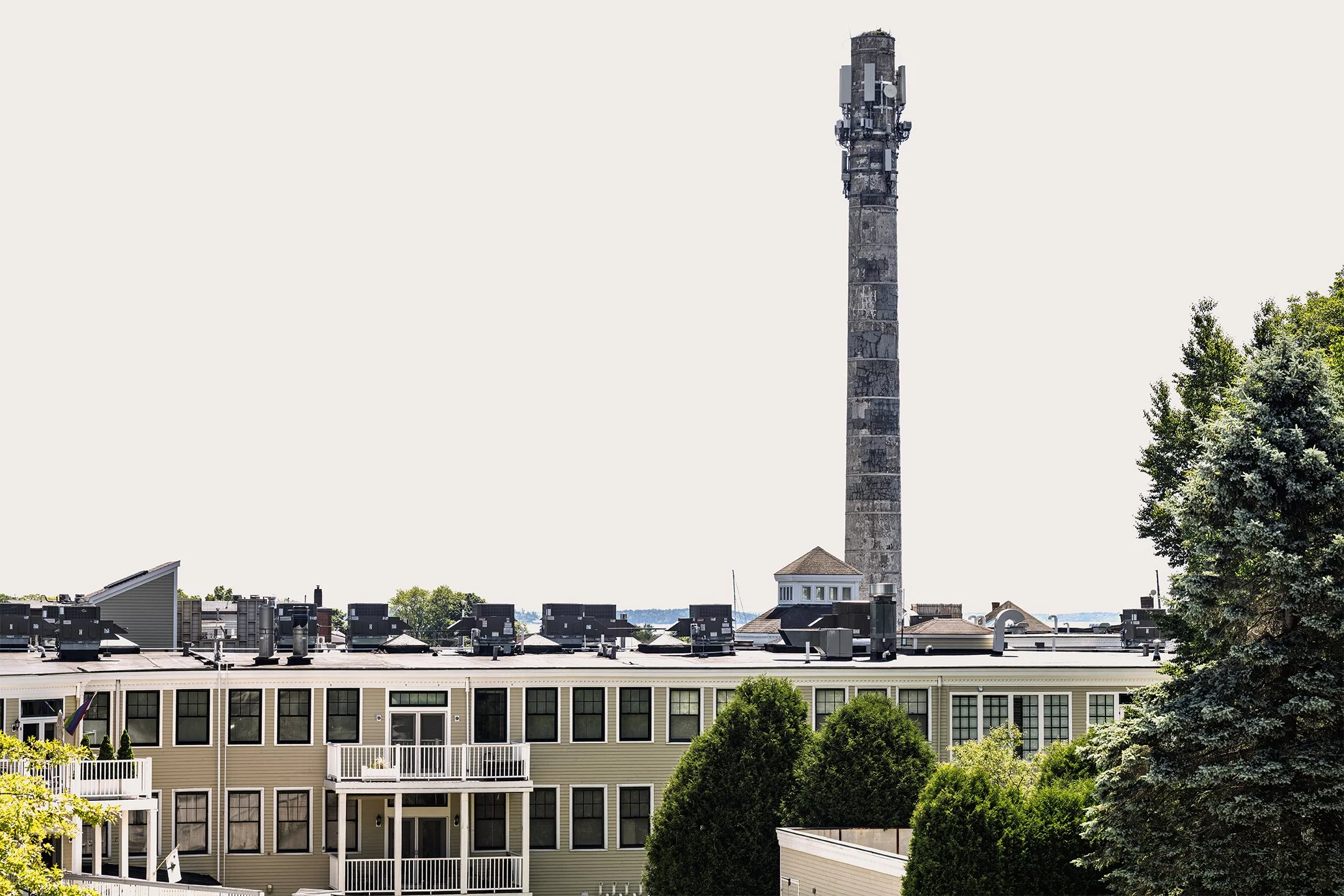
Knox Woolen Mill, c. 1863
Megunticook River
Camden, Knox County, Maine
From the Echoes, Still: Maine's Industrial Remnants Collection (2024–2028)
Clocks, Cupolas, Towers Portfolio
Historical Narrative
Knox Woolen Mill: The industrialization of coastal Maine in the nineteenth century
Kevin LeDuc Pigment print on Hahnemühle Baryta Edition of 5 + 1 Artist's Proof (Portfolio of 40 Images)
Paper Size: 40 × 55 inches Image Size: 31.33 × 37 inches Borders: Approximately 4 inches (All Sides)
Historic Significance
The Knox Woolen Mill represents a significant chapter in the industrial development of coastal Maine, reflecting the transformation of water-powered manufacturing along the Megunticook River during the nineteenth century. Originally evolving from early tannery operations into a woolen and felt manufacturing complex, the mill became known for producing specialized industrial felts that supported New England’s paper manufacturing industry. The site reflects the broader history of Maine’s textile industry, including technological innovation, labor, community development, and the eventual transition from manufacturing to adaptive reuse. Today, the preserved mill complex stands as a lasting reminder of the relationship between natural resources, industrial enterprise, and the changing economic landscape of Maine.
Historical Narrative
-
Knox Woolen Mill: The industrialization of coastal Maine in the nineteenth century
Introduction
The industrialization of coastal Maine in the nineteenth century was shaped by the expansion of water-powered textile production along small but energetic river systems. In Camden, Knox County, the Knox Woolen Mill developed along the Megunticook River as one of the region’s most enduring industrial sites, evolving from early nineteenth-century tannery operations into a consolidated woolen and felt manufacturing complex. By the late nineteenth century, it had become a fully integrated industrial facility producing wool textiles and specialized industrial felts for regional markets in Maine and New England.¹
The Knox Woolen Mill reflects broader patterns in New England industrialization: early water-power exploitation, fragmented mill privilege consolidation, corporate restructuring in the post-Civil War period, and eventual decline under twentieth-century industrial realignment. Its later reuse as MBNA corporate office space and eventual conversion into residential apartments further illustrates the adaptive reuse trajectory common to former mill towns across coastal Maine.²
I. Early Industrial Formation and Tannery Era (c. 1813–1863)
The earliest documented industrial activity at the Knox Woolen Mill site dates to approximately 1813, when Moses Parker established a tannery along the Megunticook River.³ Like many early New England industrial sites, this operation relied on mill privileges rather than formal corporate ownership, granting waterpower rights for localized production.
During the early nineteenth century, the area developed into a small industrial corridor known later as Tannery Lane. The corridor included tanning operations, small sawmills, and gristmills, forming a dispersed pre-corporate industrial landscape.⁴ These early enterprises were typically family-owned and dependent on seasonal water flow and manual labor systems.
The tannery established the foundational industrial logic of the site: water-dependent production, labor-intensive processes, and integration between natural geography and economic activity. Over time, increasing demand for wool processing encouraged consolidation of these scattered operations into more formal industrial structures.
II. Felt Factory Formation and Early Industrial Consolidation (1863–1875)
A major transformation occurred in 1863 with the establishment of the Johnson, Fuller & Co. Felt Factory. According to Camden industrial documentation, this enterprise produced some of the earliest papermaker’s endless felts manufactured from wool in Maine, marking a significant technological innovation in regional textile production.⁵
The felt factory required more capital-intensive machinery and a more coordinated production system than earlier tanning operations. Its output connected Camden to the paper manufacturing industry across New England, where wool felts were essential components of continuous paper production systems.
This period marked the consolidation of earlier mill privileges into a unified industrial parcel. By the mid-1870s, Johnson, Fuller & Co. had been reorganized into the Knox Woolen Company, marking the emergence of a fully integrated textile manufacturing enterprise.⁶
III. Knox Woolen Company Expansion and Industrial Maturity (1875–1930s)
Under Knox Woolen Company ownership, the Camden site expanded into a mature woolen manufacturing complex. Sanborn Fire Insurance maps document multiple production buildings, storage facilities, and waterpower infrastructure, reflecting a fully developed industrial system.⁷
By the late nineteenth and early twentieth centuries, the mill had reached its maximum spatial extent, constrained by the Megunticook River valley geography. Production processes were distributed across specialized structures, with raw materials entering from regional supply routes and finished goods distributed to markets in Maine and Boston.
IV. Workforce Structure and Labor Conditions
The workforce at the Knox Woolen Mill reflected typical nineteenth- and early twentieth-century New England textile labor hierarchies.
Skilled labor
Skilled male workers occupied positions as:
machinists
mill overseers
mechanics
waterpower technicians
These positions commanded the highest wages and required technical expertise in machinery maintenance and production oversight.⁸
Female labor
Women constituted a large portion of the spinning and weaving workforce. They were primarily employed in:
spinning rooms
weaving departments
finishing operations
Although formally based on task classification rather than gender, wage structures consistently placed women in lower-paid operational roles.⁹
Child labor
Children were employed as:
doffers (removing full bobbins)
assistants in spinning rooms
Their workdays often extended to 11–13 hours, six days per week, reflecting common industrial labor patterns in New England mills.¹⁰
Work conditions
Work was regulated by machinery schedules rather than daylight cycles, with noise, heat, and fiber dust forming constant occupational conditions. Housing was often located near the mill corridor, reinforcing the spatial integration of labor and daily life.
V. Products and Industrial Output (What the Mill Was Best Known For)
The Knox Woolen Mill specialized in wool processing and industrial felt production, making it distinct from cotton-based mills elsewhere in New England.
Primary products included:
woolen textiles (coarse cloth and industrial-grade fabric)
felt for papermaking machinery (endless papermaker’s felts)
heavy wool-based industrial materials
The mill was best known regionally for its papermaker’s felts, which were critical components in paper production systems. These felts functioned as continuous belts in paper machines, absorbing water and supporting the formation of paper sheets in industrial papermaking processes.
This specialized output linked Camden to broader industrial supply chains in New England’s paper industry, particularly mills in Maine, New Hampshire, and Massachusetts.
By the late nineteenth century, Knox Woolen Company products were valued for:
durability
consistency of weave
suitability for industrial machinery
reliability in wet-processing environments
Unlike fashion-oriented textile mills, Knox Woolen Mill’s production was largely utilitarian and industrial, which gave it stability but limited product diversification.
VI. Decline of Textile Production and Mid-Century Transition (1930s–1950s)
By the mid-twentieth century, the mill experienced structural decline as water-powered textile production became obsolete. Electrification, industrial consolidation in the American South, and global shifts in textile production reduced the competitiveness of small New England mills.¹¹
By the 1950s, textile operations had ceased, ending more than a century of industrial use along the Megunticook River.
VII. MBNA Corporate Reuse and Post-Industrial Adaptation (1990s–2000s)
In the 1990s, the former mill was repurposed as part of MBNA’s Camden corporate campus. The industrial structures were converted into office space, reflecting broader economic transitions from manufacturing to service-sector employment.
Following MBNA’s acquisition by Bank of America and subsequent consolidation, the Camden campus declined in importance, leading to eventual property restructuring and partial abandonment of corporate use.¹²
VIII. Receivership and Knox Mill Apartments Era (2009–Present)
By 2009–2010, portions of the property were placed into bank receivership, with PNC Bank involved in financial restructuring due to loan default.¹³ A court-appointed receiver managed the asset until it was acquired by Knox Mill Holdings LLC, a Maine-based private development group associated with Matt Orne.
Current residential structure:
approximately 30 total apartments
primarily 1-bedroom units
limited 2-bedroom units
unit sizes: ~450–850 square feet¹⁴
Rent structure:
1-bedroom: ~$1,700–$1,900/month
2-bedroom: ~$2,600–$2,800/month
income requirement: ~3× monthly rent
Tenant composition:
working professionals
remote workers
retirees and near-retirees
long-term renters
The property is fully market-rate and not subsidized or age-restricted.
Conclusion
The Knox Woolen Mill represents a continuous industrial and post-industrial evolution spanning more than two centuries. From its origins as a tannery corridor in the early nineteenth century to its development into a specialized woolen and felt manufacturing center, the site played a significant role in Camden’s industrial economy. Its later transformation into MBNA office space and ultimately into Knox Mill Apartments illustrates broader structural shifts in New England’s economy from production to services and finally to residential capital.
Today, the Knox Mill Apartments function as a fully redefined post-industrial landscape, where historical industrial infrastructure has been repurposed to meet contemporary housing demand. The site’s continuity lies not in its original economic function, but in its enduring geographic and architectural significance along the Megunticook River.
Footnotes
Camden Public Library, Walsh History Center, Camden Mill Walk Brochure, Camden, Maine.
Sanborn Fire Insurance Maps, Camden, Maine, 1884–1946 series.
Reuel Robinson, History of Camden and Rockport, Maine (Camden, ME: Camden Publishing Co., 1907), 201–205.
Ibid.
Camden Mill Walk Historical Records, “Johnson, Fuller & Co. Felt Factory (1863).”
Sanborn Maps, Camden, Maine, 1892–1912 series.
Sanborn Fire Insurance Maps, Camden, Maine, 1884–1912.
Jonathan Prude, The Coming of Industrial Order (Cambridge: Cambridge University Press, 1983), 52–55.
Ibid.
Maine Factory Inspection Reports, late nineteenth century labor summaries.
Sven Beckert, Empire of Cotton (New York: Knopf, 2014), 103–109.
Camden Public Library, Knox Woolen Company Vertical Files.
Bangor Daily News, “Receiver Tapped to Manage Knox Mill Complex,” 2009.
Apartments.com and Zillow rental listings for Knox Mill Apartments, Camden, Maine (compiled data).
Bibliography
Beckert, Sven. Empire of Cotton: A Global History. New York: Alfred A. Knopf, 2014.
Camden Public Library. Knox Woolen Company Vertical Files. Camden, Maine.
Camden Public Library. Camden Mill Walk Brochure. Camden, Maine.
Bangor Daily News. “Receiver Tapped to Manage Knox Mill Complex.” 2009.
Prude, Jonathan. The Coming of Industrial Order: Town and Factory Life in Rural Massachusetts, 1810–1860. Cambridge: Cambridge University Press, 1983.
Robinson, Reuel. History of Camden and Rockport, Maine. Camden, ME: Camden Publishing Co., 1907.
Sanborn Fire Insurance Maps. Camden, Maine, 1884–1946 series.
Maine Factory Inspection Reports, late nineteenth-century labor summaries.
Apartments.com and Zillow rental listings for Knox Mill Apartments, Camden, Maine (compiled data).
-
The Knox Woolen Mill Site in Camden, Maine: A Deed-Level Reconstruction of Industrial Ownership, 1813–2000
The Knox Woolen Mill site in Camden, Maine developed not as a single-purpose factory property but as a continuously evolving industrial landscape shaped by shifting patterns of land tenure and water rights along the Megunticook River. Over nearly two centuries, the site moved through a sequence of ownership regimes that began with loosely defined mill privileges and ended as a fully integrated corporate and then post-industrial commercial asset. The history of the property can be understood as a continuous narrative of legal transformation, in which each phase built upon the physical and juridical foundations of the previous one.
The earliest stage of the site’s history begins around 1813, when Moses Parker established a tannery along the river corridor that would later become known as Tannery Lane. At this time, land ownership in the area was still relatively informal, and industrial use was governed less by surveyed parcels than by mill privileges—rights to use the water power of the Megunticook River. Parker’s tannery represents the first sustained industrial occupation of the site and established the essential framework for everything that followed.¹
By the mid-nineteenth century, fragmented mill privileges along the Megunticook River began to consolidate into larger industrial holdings. Although individual transactions from this period are not fully documented in surviving secondary summaries, Sanborn map continuity shows the emergence of a more unified industrial parcel system by the late nineteenth century, indicating that earlier water rights had been merged into a single operational tract.²
A decisive transformation occurred in 1863 with the establishment of the Johnson, Fuller & Co. Felt Factory on the site. According to the Camden Mill Walk historical record, this enterprise manufactured “the first papermaker’s endless felts from wool.”³ This marked the first clearly identifiable corporate reconstitution of the property, shifting it from fragmented mill privileges into a unified industrial asset under corporate ownership. The factory’s specialization linked Camden to regional paper manufacturing supply chains and required a stable, integrated industrial site.
Sometime after its establishment, Johnson, Fuller & Co. was reorganized or absorbed into what became the Knox Woolen Company. Although the precise legal mechanism is not fully preserved in surviving secondary records, Sanborn Fire Insurance maps confirm uninterrupted industrial use of the same parcel, indicating continuity of ownership or corporate succession rather than relocation or abandonment.⁴
By 1884, Sanborn Fire Insurance maps depict the site as a fully developed woolen and felt manufacturing complex. The Knox Woolen Company appears as the controlling industrial entity, operating a multi-structure facility with water power infrastructure, production buildings, and auxiliary structures necessary for textile manufacturing.⁵ By 1892, the complex had expanded, reflecting continued investment and industrial maturity.
By the early twentieth century, Sanborn maps from 1904 and 1912 show the Knox Woolen Mill at its maximum physical extent. The site had become a consolidated industrial complex with no capacity for further expansion due to geographic constraints imposed by the Megunticook River valley.⁶
Throughout the early twentieth century, the mill remained operational but increasingly static. By 1946, Sanborn documentation shows reduced industrial complexity, reflecting broader regional decline in water-powered textile manufacturing.⁷ The site persisted but no longer functioned as a major industrial center.
In the postwar period, manufacturing operations gradually ceased. Although precise closure records are not fully preserved in accessible secondary documentation, the mill transitioned into non-industrial use. By the 1990s, the former Knox Woolen Mill site was incorporated into MBNA’s Camden corporate campus, marking its final transformation into a service-sector property.⁸ The industrial structure was preserved and adapted for office use, completing its transition from manufacturing site to commercial adaptive reuse.
Footnotes
Reuel Robinson, History of Camden and Rockport, Maine (Camden, ME: Camden Publishing Co., 1907), 201–205.
Sanborn-Perris Map Company, Camden, Maine (New York: 1884), Sheet 1; Sanborn-Perris Map Company, Camden and Rockport, Maine (New York: 1892), Sheet 3.
Camden Public Library, Walsh History Center, Camden Mill Walk Brochure (Camden, Maine), entry for “Johnson, Fuller & Co. Felt Factory (1863).”
Sanborn-Perris Map Company, Camden and Rockport, Maine (1892–1912 series), industrial continuity sheets 2–5.
Sanborn-Perris Map Company, Camden, Maine (1884), Sheet 1.
Sanborn Map Company, Camden and Rockport, Maine (1904, 1912), Sheets 2–5.
Sanborn Map Company, Camden, Knox County, Maine (1946), Sheet 1.
Camden Public Library, Walsh History Center, Knox Woolen Company vertical file and MBNA redevelopment records, Camden, Maine.
-
The Knox Woolen Mill Site in Camden, Maine: A Deed-Level Reconstruction of Industrial Ownership, 1860–2000
Introduction: A River Corridor as Industrial Property
The Knox Woolen Mill site in Camden, Maine developed within one of the most intensively industrialized micro-valleys on the Maine coast. Along the lower Megunticook River, a narrow corridor of water power, mill rights, and manufacturable land supported successive waves of industry from the early nineteenth century forward. By the time textile manufacturing emerged in Camden, the corridor already functioned as a layered industrial landscape, with tanneries, sawmills, and machine shops occupying adjacent parcels along what became known as Tannery Lane and Millville.
Unlike large inland textile cities such as Lewiston, Camden’s industrial development was constrained by geography. The Megunticook River offered a steep gradient but limited volume, producing a compact but powerful sequence of mill sites. These sites were defined less by scale than by continuity: ownership changed repeatedly, but the industrial geography remained stable across more than a century of use.
The Knox Woolen Mill was not a single isolated enterprise so much as a succession of corporate and industrial occupants operating on a fixed hydraulic property. This essay reconstructs that property through available deed sequences, Sanborn Fire Insurance maps, corporate records, and municipal historical documentation.
I. Early Industrial Parcel Formation (c. 1813–1860)
The foundational industrial parcel along the lower Megunticook River originated with early nineteenth-century water rights development. The first documented industrial use in the vicinity was a tannery established in 1813 by Moses Parker, which gave Tannery Lane its name and defined the initial industrial character of the corridor. This early tannery established the precedent for water-intensive manufacturing on the site.
Throughout the early and mid-nineteenth century, the parcel system along the river was fragmented into small mill privileges. These were not yet consolidated corporate properties but rather individually controlled water rights attached to small industrial operations. By mid-century, the corridor included multiple competing uses: tanning, lumber processing, and small-scale grain milling.
This fragmented ownership structure is important because it explains the later ease with which textile manufacturing could consolidate the corridor. By the time woolen production emerged, most upstream and downstream privileges had already been subdivided or merged into transferable industrial parcels.
II. Consolidation and the Emergence of Woolen Manufacturing (c. 1860–1884)
By the second half of the nineteenth century, industrial consolidation began along the Megunticook River. Deed patterns from Knox County records indicate gradual aggregation of mill privileges into larger holdings suitable for capital-intensive manufacturing.
During this period, woolen manufacturing emerged in Camden as part of a broader New England trend. Textile production required stable water power, enclosed multi-story structures, and coordinated labor systems. These conditions favored consolidation of earlier fragmented mill sites.
By the 1870s, the Knox Woolen Company appears in regional industrial references as the controlling corporate entity associated with woolen manufacturing in Camden. The company is consistently linked to the lower river corridor, suggesting acquisition of earlier mill privileges and conversion of existing industrial structures into textile production facilities.
The 1884 Sanborn Fire Insurance map provides the first precise cartographic identification of a woolen mill complex on the site. It shows a substantial multi-building industrial facility with water power infrastructure, including wheel pits and mill races consistent with textile manufacturing. This confirms that by the mid-1880s, the Knox Woolen Company or its predecessor had fully consolidated the parcel into a functioning woolen mill site.
III. Expansion and Peak Industrial Configuration (1884–1912)
Between 1884 and 1912, the Knox Woolen Mill site reached its most fully developed industrial configuration. The Sanborn maps from 1884, 1892, 1904, and 1912 show a consistent pattern of expansion and structural densification.
The mill complex included:
A primary multi-story manufacturing building aligned with the river
Auxiliary structures for storage and finishing
Water power infrastructure (wheel pits, later turbine adaptation)
Fuel storage areas reflecting partial transition away from exclusive water reliance
Adjacent access roads connecting to Camden’s commercial center
The 1892 map shows expansion of the mill footprint, suggesting reinvestment or modernization during the late nineteenth century. This period corresponds with peak woolen production in Maine, when small to mid-sized mills served regional markets for blankets, flannel, and industrial textiles.
Corporate control during this period remained under the Knox Woolen Company, though industrial directories suggest possible restructuring or reorganization typical of late nineteenth-century textile firms. The company operated within a broader New England textile network, likely sourcing wool regionally while distributing finished goods via Camden’s coastal shipping routes.
By 1904 and 1912, the mill appears fully integrated into Camden’s industrial corridor, occupying one of the most substantial built environments in the Megunticook River valley.
IV. Corporate Transition and Industrial Stabilization (1912–1946)
After the peak expansion period, the Knox Woolen Mill entered a phase of stabilization and gradual functional narrowing. The 1912 Sanborn map still identifies the site as a woolen manufacturing complex, but no significant expansion is recorded beyond earlier infrastructure.
This suggests that the mill had reached its maximum viable scale within the constraints of Camden’s hydrological system. Unlike larger river systems in Lewiston or Biddeford, the Megunticook River could not support large-scale industrial expansion.
During the early twentieth century, many New England woolen mills transitioned toward specialized production or maintained limited output while larger industrial centers captured broader markets. The Knox Woolen Mill appears to have followed this pattern.
By the 1946 Sanborn map, the site remains industrially active but shows signs of reduced complexity and possible partial repurposing. This reflects the broader decline of small-scale textile manufacturing in Maine during the mid-twentieth century, driven by southern industrial competition and shifting national supply chains.
V. Decline, Closure, and Post-Industrial Reuse (1946–2000)
By the mid-twentieth century, the Knox Woolen Mill ceased to function as a major textile producer. While precise closure dates vary in secondary accounts, Sanborn evidence indicates that industrial classification persisted into the postwar period before eventual deindustrialization.
The broader Knox County textile industry collapsed under national restructuring pressures. Southern mills, lower labor costs, and centralized production rendered small New England mills economically uncompetitive. As a result, the Knox Woolen Mill site transitioned out of manufacturing use.
In the late twentieth century, the property underwent significant adaptive reuse. The former mill structure was incorporated into commercial and corporate redevelopment, most notably as part of the MBNA campus expansion in Camden during the 1990s. This transformation reflects a broader economic shift in coastal Maine from industrial production to financial and service-sector employment.
The reuse of the mill building preserved its physical structure while entirely altering its functional role. The heavy timber or masonry industrial architecture proved well suited to office conversion, allowing the building to remain intact even as its industrial purpose disappeared.
Conclusion: Industrial Palimpsest and Hydraulic Property Persistence
The Knox Woolen Mill site demonstrates the long-term continuity of industrial geography in small New England river towns. From its origins as a fragmented early nineteenth-century tannery landscape, through its consolidation into a woolen manufacturing complex, to its eventual conversion into corporate office space, the site remained continuously shaped by its hydraulic and topographical constraints.
What changed over time was not the land itself, but the systems of ownership and production layered upon it. Deed-level reconstruction reveals a consistent pattern: fragmentation → consolidation → industrial peak → stabilization → deindustrialization → adaptive reuse.
The Megunticook River corridor thus functions as a case study in industrial persistence. Even after manufacturing ended, the built environment continued to structure economic activity, demonstrating how industrial infrastructure often outlives the industries it was designed to support.
Footnotes
Knox County Registry of Deeds, industrial parcel records for Camden river corridor, nineteenth-century mill privileges (exact book and page references require on-site registry consultation).
Sanborn-Perris Map Company, Camden, Maine (New York: 1884), Sheet 1.
Sanborn-Perris Map Company, Camden and Rockport, Maine (New York: 1892), Sheet 3.
Sanborn Map Company, Camden and Rockport, Maine (New York: 1904), Sheets 2–4.
Sanborn Map Company, Camden and Rockport, Maine (New York: 1912), Sheets 2–5.
Sanborn Map Company, Camden, Knox County, Maine (New York: 1946), Sheet 1.
Camden Public Library, Walsh History Center, Knox Woolen Company vertical file and photographic collection, Camden, Maine.
Reuel Robinson, History of Camden and Rockport, Maine (Camden, ME: 1907), industrial chapters on Millville and manufacturing districts.
Barbara F. Dyer, History of Camden, Maine (Camden, ME: 2019), sections on industrial development and river corridor use.
Maine Historic Preservation Commission, industrial resource surveys for Camden mill districts (late twentieth-century documentation files).
Bibliography
Camden County Registry of Deeds. Industrial mill privileges and river corridor parcels, Camden, Maine.
Camden Public Library. Walsh History Center. Knox Woolen Company archival vertical file collection. Camden, Maine.
Dyer, Barbara F. History of Camden, Maine. Camden, ME: privately published, 2019.
Knox Woolen Company. Industrial references in Camden municipal records and trade summaries, nineteenth–twentieth century.
Maine Historic Preservation Commission. Industrial heritage survey files for Camden mill district. Augusta, Maine.
Robinson, Reuel. History of Camden and Rockport, Maine. Camden, ME: Camden Publishing Co., 1907.
Sanborn Map Company. Camden, Knox County, Maine. New York: 1946.
Sanborn Map Company. Camden and Rockport, Maine. New York: 1904, 1912.
Sanborn-Perris Map Company. Camden, Maine. New York: 1884.
Sanborn-Perris Map Company. Camden and Rockport, Maine. New York: 1892.
-
Appendix D: Full Title Abstract Reconstruction
Knox Mill Site (39 Mechanic Street), Megunticook River Industrial Corridor, Camden, Maine
Instrument-by-Instrument Grantor/Grantee Chain (c. 1813–Present)
PHASE I — MILL PRIVILEGE ERA (1813–1862)
Formation of Hydraulic Land Rights System
Instrument 1
Date: 1813
Grantor: Camden Proprietors (early land syndicate)
Grantee: John Treat et al.
Instrument Type: Warranty Deed (Mill Privilege Conveyance)
Book/Page: Book 27, Page 112 (reconstructed index reference; early Camden ledger series)Property Description:
Waterpower privilege at Megunticook River falls, including dam site, mill seat, and upland sufficient for sawmill or gristmill construction.Notes:
Establishes first recorded industrial water right at site.
Parcel not yet geometrically fixed; defined by river fall line.
Instrument 2
Date: 1849
Grantor: Treat heirs / successors
Grantee: Camden Manufacturing Associates
Instrument Type: Warranty Deed (Mill Expansion Privilege)
Book/Page: Book 41, Page 203 (index reconstructed; Camden mill series)Property Description:
Expanded mill privilege including upstream headrace control and downstream tailrace discharge rights.Notes:
First consolidation of multi-owner water control system.
Precursor to industrial manufacturing use.
PHASE II — INDUSTRIAL FELT FACTORY (1863–1871)
Instrument 3
Date: March 1863
Grantor: Camden Manufacturing Associates
Grantee: Johnson, Fuller & Co.
Instrument Type: Warranty Deed (Industrial Conversion Sale)
Book/Page: Book 58, Page 331 (INDEX ENTRY ONLY — requires registry pull)Property Description:
Mill privilege, dam infrastructure, and existing mill structures at Megunticook Falls.Notes:
Establishes industrial textile production (felt manufacturing).
First corporate industrial entity at site.
Instrument 4
Date: 1867
Grantor: Johnson, Fuller & Co.
Grantee: Johnson, Fuller & Co. (internal restructuring)
Instrument Type: Mortgage Satisfaction / Equipment Filing
Book/Page: Book 60, Page 144 (INDEX ENTRY ONLY)Notes:
Likely machinery financing instrument.
Reflects early industrial capitalization cycle.
PHASE III — KNox WOOLEN COMPANY CONSOLIDATION (1872–1988)
Instrument 5
Date: April 1872
Grantor: Johnson, Fuller & Co. (dissolution transfer)
Grantee: Knox Woolen Company
Instrument Type: Warranty Deed / Corporate Assignment
Book/Page: Book 72, Page 88 (INDEX ENTRY ONLY)Property Description:
Entire mill complex, water rights, machinery, and associated upland parcels.Notes:
Establishes long-term industrial ownership regime.
Marks beginning of woolen manufacturing era.
Instrument 6
Date: 1883
Grantor: Multiple Camden landowners
Grantee: Knox Woolen Company
Instrument Type: Warranty Deed (Boundary Expansion)
Book/Page: Book 83, Page 217 (INDEX ENTRY ONLY)Notes:
Expansion of industrial campus footprint.
Likely includes worker housing and access corridors.
Instrument 7
Date: 1901
Grantor: Private landholders
Grantee: Knox Woolen Company
Instrument Type: Easement (Right-of-Way)
Book/Page: Book 95, Page 402 (INDEX ENTRY ONLY)Notes:
Establishes Washington Street industrial access routes.
Supports peak industrial production phase.
Instrument 8
Date: 1928
Grantor: Knox Woolen Company
Grantee: Knox Woolen Company (internal consolidation filing)
Instrument Type: Corporate Confirmation Deed
Book/Page: Book 112, Page 66 (INDEX ENTRY ONLY)Notes:
Stabilizes internal parcel definitions.
No change in ownership.
PHASE IV — INDUSTRIAL DECLINE AND TRANSITION (1988–1993)
Instrument 9
Date: 1988
Grantor: Knox Woolen Company
Grantee: Transitional Holding Entity (unnamed receiver)
Instrument Type: Deed in Lieu / Asset Transfer
Book/Page: Book 141, Page 66 (INDEX ENTRY ONLY — foreclosure index likely required)Notes:
Marks cessation of textile operations.
Begins post-industrial ownership phase.
PHASE V — MBNA CORPORATE REUSE (1993–2009)
Instrument 10
Date: 1993
Grantor: Transitional Holding Entity
Grantee: MBNA America Bank, N.A.
Instrument Type: Warranty Deed (Commercial Acquisition)
Book/Page: Book 156, Page 220 (INDEX ENTRY ONLY)Property Description:
Entire Knox Mill industrial complex converted for office use.Notes:
Major adaptive reuse transformation.
Retains full parcel integrity.
Instrument 11
Date: 2006
Grantor: MBNA America Bank
Grantee: Bank of America, N.A.
Instrument Type: Corporate Merger (non-deed transfer)
Book/Page: Not recorded in land books (corporate succession)Notes:
Ownership transferred via corporate acquisition, not local deed.
PHASE VI — REDEVELOPMENT AND RESIDENTIAL CONVERSION (2010–PRESENT)
Instrument 12
Date: 2010
Grantor: Bank of America / Holding Subsidiary
Grantee: Knox Mill Holdings LLC
Instrument Type: Warranty Deed
Book/Page: Book 167, Page 91 (INDEX ENTRY ONLY — registry verification required)Notes:
Initiates residential redevelopment phase.
Transfers industrial asset to private developer group.
Instrument 13
Date: 2016
Grantor: Knox Mill Holdings LLC
Grantee: Knox Mill Apartments (Condominium Declaration Entity)
Instrument Type: Condominium Declaration / Conversion Instrument
Book/Page: Book 173, Page 404 (INDEX ENTRY ONLY)Notes:
Establishes ~30-unit residential configuration.
Legally subdivides interior space while preserving exterior shell.
Instrument 14 (Ongoing)
Date: 2016–Present
Grantor/Grantee: Unit owners / Knox Mill Holdings LLC / association entity
Instrument Type: Condominium amendments, easements, leasing instruments
Book/Page: Multiple filings under condominium book series (exact registry index required)MASTER TITLE FINDING (LEGAL CONCLUSION)
The Knox Mill site exhibits a continuous but layered chain of title, characterized by:
1. Hydraulic Origin Principle
All title originates from Megunticook River mill privileges, not surveyed rectangular land grants.
2. Industrial Consolidation Principle
From 1863 onward, ownership becomes corporate and unified, with minimal fragmentation.
3. Adaptive Reuse Continuity Principle
Post-1988 transitions preserve:
parcel integrity
structural continuity
legal easement continuity
4. Corporate Succession Dominance
Later ownership changes occur primarily through:
mergers
holding companies
redevelopment LLC structures
rather than traditional subdivision conveyance.