Kevin LeDuc
Kevin LeDuc
An American Photographer

The Emigrant’s Adieu to Ballyshannon

William Allingham (1824–1889)

A LOCAL BALLAD

Adieu to Ballyshannon! where I was bred and born;

Go where I may, I'll think of you, as sure as night and morn.

The kindly spot, the friendly town, where every one is known,

And not a face in all the place but partly seems my own;

There's not a house or window, there's not a field or hill,

But, east or west, in foreign lands, I recollect them still.

I leave my warm heart with you, tho' my back I'm forced to turn

Adieu to Ballyshannon, and the winding banks of Erne!

No more on pleasant evenings we'll saunter down the Mall,

When the trout is rising to the fly, the salmon to the fall.

The boat comes straining on her net, and heavily she creeps,

Cast off, cast off— she feels the oars, and to her berth she sweeps;

Now fore and aft keep hauling, and gathering up the clew,

Till a silver wave of salmon rolls in among the crew. 

Then they may sit, with pipes a-lit, and many a joke and “yarn”;—

Adieu to Ballyshannon; and the winding banks of Erne!

The music of the waterfall, the mirror of the tide,

When all the greenhill'd harbour is full from side to side,

From Portnasun to Bulliebawns, and round the Abbey Bay,

From rocky Inis Saimer to Coolnargit sand-hills gray;

While far upon the southern line, to guard it like a wall,

The Leitrim mountains clothed in blue gaze calmly over all,

And watch the ship sail up or down, the red flag at her stern;—

Adieu to these, adieu to all the winding banks of Erne!

Farewell to you, Kildoney lads, and them that pull an oar,

A lug-sail set, or haul a net, from the Point to Mullaghmore;

From Killybegs to bold Slieve-League, that ocean-Mountain steep,

Six hundred yards in air aloft, six hundred in the deep, 

From Dooran to the Fairy Bridge, and round by Tullen strand,

Level and long, and white with waves, where gull and curlew stand;

Head out to sea when on your lee the breakers you discern!—

Adieu to all the billowy coast, and winding banks of Erne!

Farewell, Coolmore—Bundoran! And your summer crowds that run

From inland homes to see with joy th'Atlantic-setting sun;

To breathe the buoyant salted air, and sport among the waves;

To gather shells on sandy beach, and tempt the gloomy caves;

To watch the flowing, ebbing tide, the boats, the crabs, the fish;

Young men and maids to meet and smile, and form a tender wish;

The sick and old in search of health, for all things have their turn—

And I must quit my native shore, and the winding banks of Erne!

Farewell to every white cascade from the Harbour to Belleek,

And every pool where fins may rest, and ivy-shaded creek;

The sloping fields, the lofty rocks, where ash and holly grow,

The one split yew-tree gazing on the curving flood below;

The Lough, that winds through islands under Turaw mountain green;

And Castle Caldwell's stretching woods, with tranquil bays between;

And Breesie Hill, and many a pond among the heath and fern,—

For I must say adieu—adieu to the winding banks of Erne!

The thrush will call through Camlin groves the live-long summer day;

The waters run by mossy cliff, and banks with wild flowers gay;

The girls will bring their work and sing beneath a twisted thorn,

Or stray with sweethearts down the path among growing corn; 

Along the river-side they go, where I have often been,

O, never shall I see again the days that I have seen!

A thousand chances are to one I never may return,—

Adieu to Ballyshannon, and the winding banks of Erne!

Adieu to evening dances, when merry neighbours meet,

And the fiddle says to boys and girls, “Get up and shake your feet!”

To shanachus and wise old talk of Erin's days gone by—

Who trench'd the rath on such a hill, and where the bones may lie

Of saint, or king, or warrior chief; with tales of fairy power,

And tender ditties sweetly sung to pass the twilight hour.

The mournful song of exile is now for me to learn—

Adieu, my dear companions on the winding banks of Erne!

Now measure from the Commons down to each end of the Purt,

Round the Abbey, Moy, and Knather— I wish no one any hurt;

The Main Street, Back Street, College Lane, the Mall, and Portnasun, 

If any foes of mine are there, I pardon every one.

I hope that man and womankind will do the same by me;

For my heart is sore and heavy at voyaging the sea.

My loving friends I'll bear in mind, and often fondly turn

To think of Ballyshannon, and the winding banks of Erne.

If ever I'm a money'd man, I mean, please God, to cast

My golden anchor in the place where youthful years were pass'd;

Though heads that now are black and brown must meanwhile gather gray,

New faces rise by every hearth, and old ones drop away—

Yet dearer still that Irish hill than all the world beside;

It's home, sweet home, where'er I roam, through lands and waters wide.

And if the Lord allows me, I surely will return

To my native Ballyshannon, and the winding banks of Erne.

FIFTY MODERN POEMS, XXVII

Bell & Daldy, London, 1865, pp.111-118

No.00_DSC0340 12x08.08.200 JPEG UA10 Enhance SR.6A.jpg
 

Cathedrals, Ashes of Dreams

Cathedrals, Ashes of Dreams captures the grandeur, grit, and quiet decay of America’s industrial heart. From soaring steel mills to hushed textile factories, each photograph tells the story of families who built homes, forged communities, and pursued the American dream of independence, hard work, and hope. These images immortalize the hands, hearts, and perseverance of those whose labor and family lives were inseparably intertwined, shaping an era that defined a nation. The photographs trace the rhythm of daily life—the clang of steel, the hum of looms, and the warmth of Mom-and-Pop stores that served as the lifeblood of countless towns. In every frame, Cathedrals, Ashes of Dreams evokes the poetry of resilience, the weight of legacy, and the lingering shadows of lost dreams—reminders of ambitions, lives, and communities that once breathed vitality into these industrial landscapes. It is a meditation on creation and decline, on hope and impermanence, and on the enduring spirit of the people whose stories remain etched into the steel, brick, and memory of a vanished world.

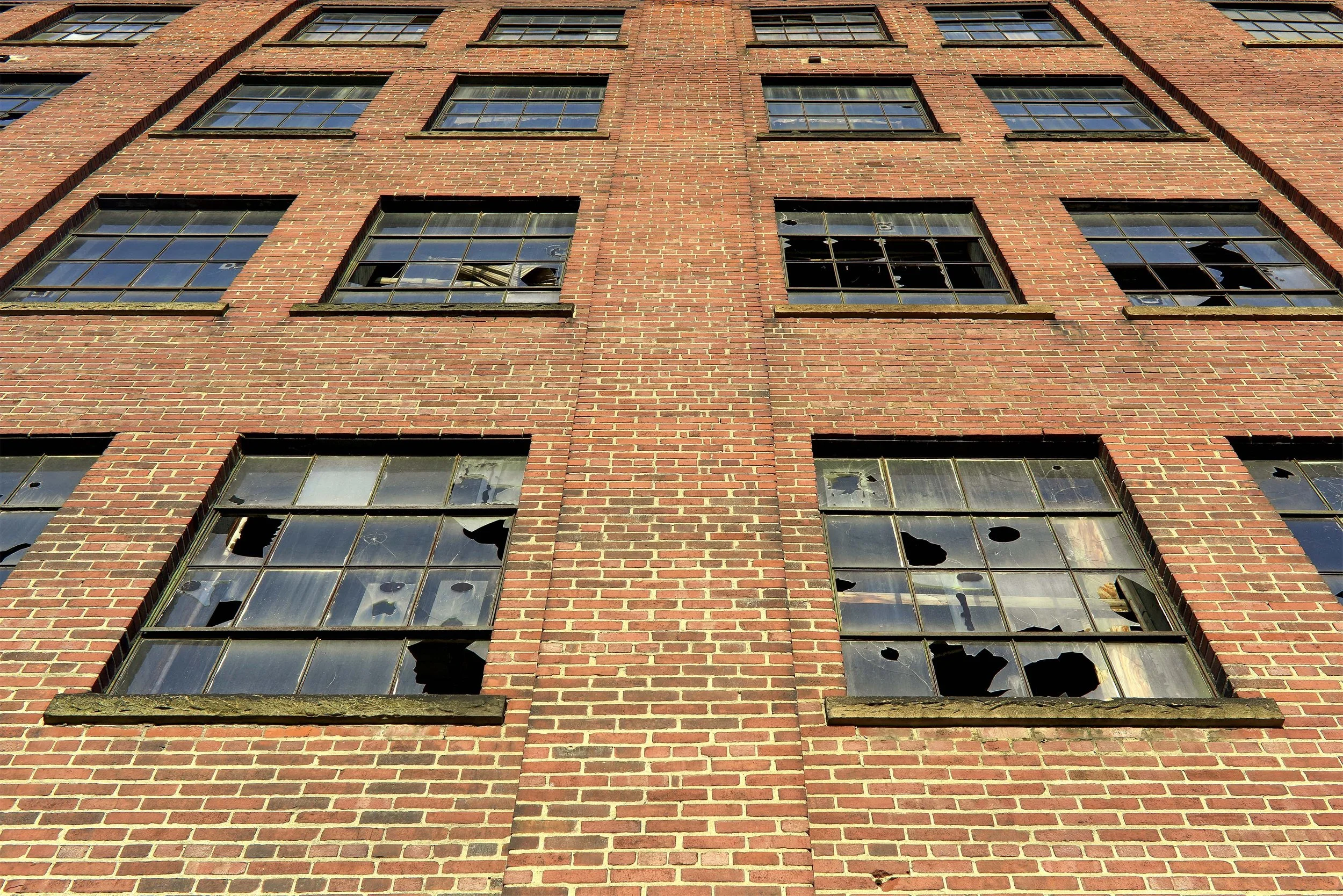
Broken Windows storyline centers on the heartbreaking phenomenon of manufacturers abandoning their factories and mills, leaving behind structures that once thrived with life and productivity. As these industrial sites fall into decay, the echoes of machinery and the industrious hum of workers fade into silence. The once-bustling communities that relied on these businesses for their livelihoods face economic decline and social fragmentation, as families struggle to adapt to the loss of jobs and the decline of local infrastructure. Places that once thrived with activity — parks, shops, and gathering places—are now empty or in disrepair. Neighborhoods that were once vibrant and interconnected have become isolated, residents are forced to leave in search of work. Amid this turmoil, the decline of local businesses leads to a loss of identity and erodes the very fabric of community life.

Shadows in Silence portrays the aftermath of industrial decline as something deeply felt across cities in the Rust Belt, where disenfranchised and disheartened residents navigate the remnants of a once-thriving economy. Abandoned factories loom over neighborhoods like ghosts of prosperity past, serving as stark reminders of the jobs and opportunities that have vanished. Streets are often lined with shuttered churches, their steeples bent and roofs caving in, symbolizing the erosion of faith and social cohesion. Condemned and abandoned homes line nearly every street, reinforcing the scale of displacement and neglect. Local businesses—once cherished mom-and-pop shops—now stand empty, their windows shattered or boarded up, each closure telling a story of dreams unfulfilled and families struggling to survive. Homes throughout these neighborhoods bear the marks of neglect, with peeling paint and overgrown yards reflecting a loss of care and investment. In the wake of this decline, broader societal ills take hold, including rising debt, homelessness, substance abuse, and increasing rates of suicide. This landscape of decay breeds a pervasive sense of hopelessness, trapping those left behind in a cycle of poverty and despair.

Fragile Promise is a meditation on the aftermath of conflict, where societies drift through scarred landscapes and a heavy stillness settles over what remains of their neighborhoods. Communities grapple with loss, fear, and uncertainty, as streets that once pulsed with life lie hollow, marked by ruin and absence. Yet amid the rot of carnage and chaos, a quiet, remarkable resilience begins to stir as survivors gather—not out of certainty, but necessity. From the shadows of devastation, a fragile promise flickers—uncertain, unsteady, yet impossible to extinguish.

Alchemy in this series becomes a framework through which the human experience is captured, using external imagery of architecture to explore transformation. The structures—walls, arches, patterns, and decayed facades—mirror the alchemical journey, reflecting the interplay between external change and internal growth. Each image invites contemplation of personal paths toward enlightenment, revealing how our surroundings shape understanding of the universe and the divine. Through this visual metaphor, the work gestures toward the emergence of enduring, almost eternal qualities within human experience, while also questioning the future of identity in a world increasingly intertwined with AI and transhuman frontiers.


To work without pleasure or affection, to make a product that is not both useful and beautiful, is to dishonor God, nature, the thing that is made, and whomever it is made for.
— Wendell Berry 2003

BROKEN WINDOWS


Fragile Promise

Shadows in Silence


ALCHEMY